How Much Does a Wedding in Italy Cost in 2026 / 2027 / 2028 ?
Planning a wedding in Italy sounds romantic in theory, but once you start trying to put numbers against the dream, things can get confusing very quickly. One article will tell you that you can do it all for €10,000, While another jumps straight to six figures.
What are you meant to believe? Neither is especially helpful when you are trying to understand what a realistic budget actually looks like.
The truth is that the cost of a wedding in Italy depends less on the country itself and more on the type of experience you are creating. A more intimate and self-managed celebration will sit in a very different range from a fully styled villa wedding with multiple suppliers, extra events, and a higher level of guest experience. What matters most is understanding where the money actually goes.
As a general guide here are some real numbers in Euros to give you a better idea,
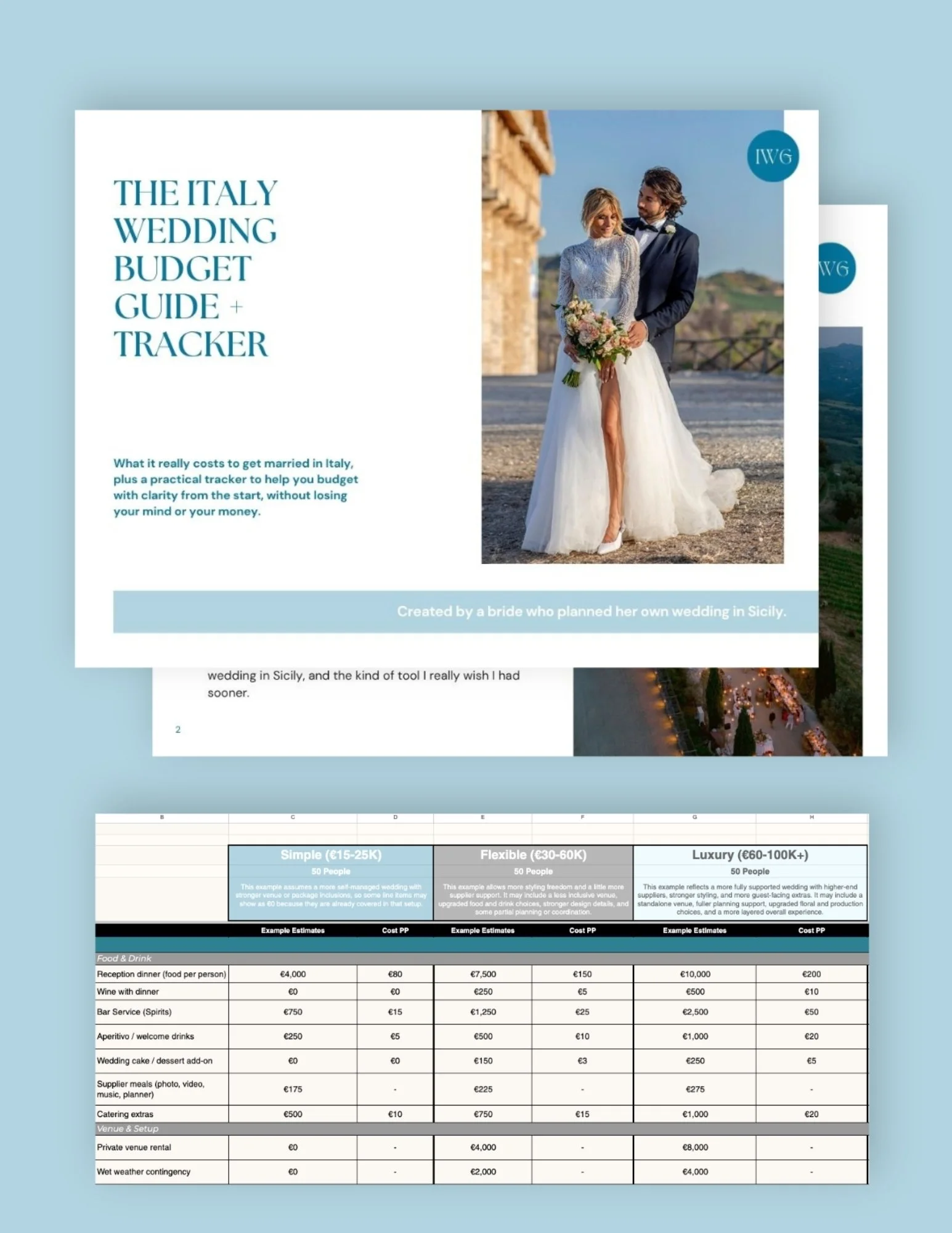
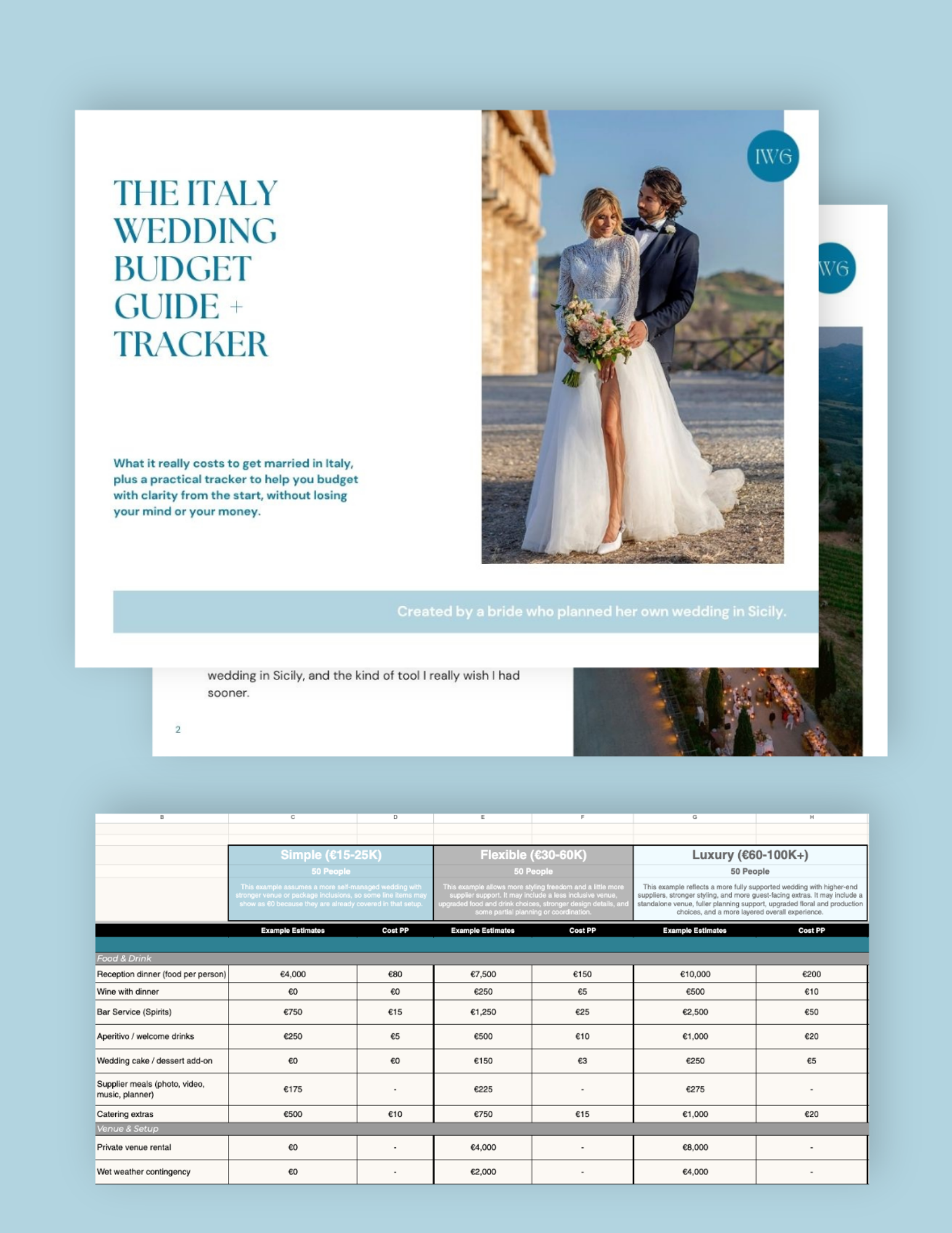
A simple wedding in Italy will often fall between €15,000 and €25,000.
A more flexible mid-range celebration usually lands somewhere between €30,000 and €60,000.
While a more luxury-led wedding can easily sit between €60,000 and €100,000 or more.
These are not just aesthetic differences. They reflect venue style, supplier choices, planning support, guest count, and how many extras are built into the overall experience.
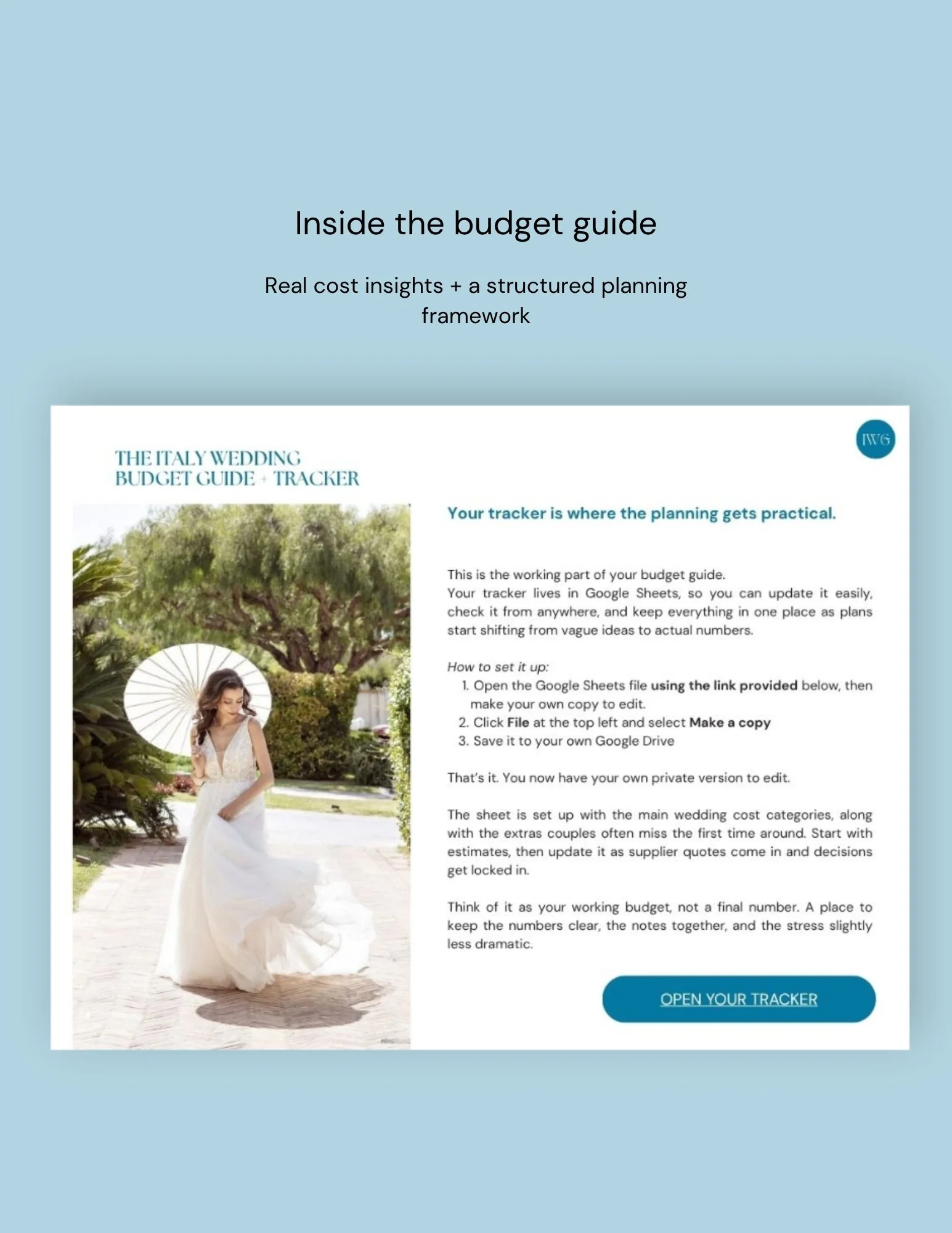
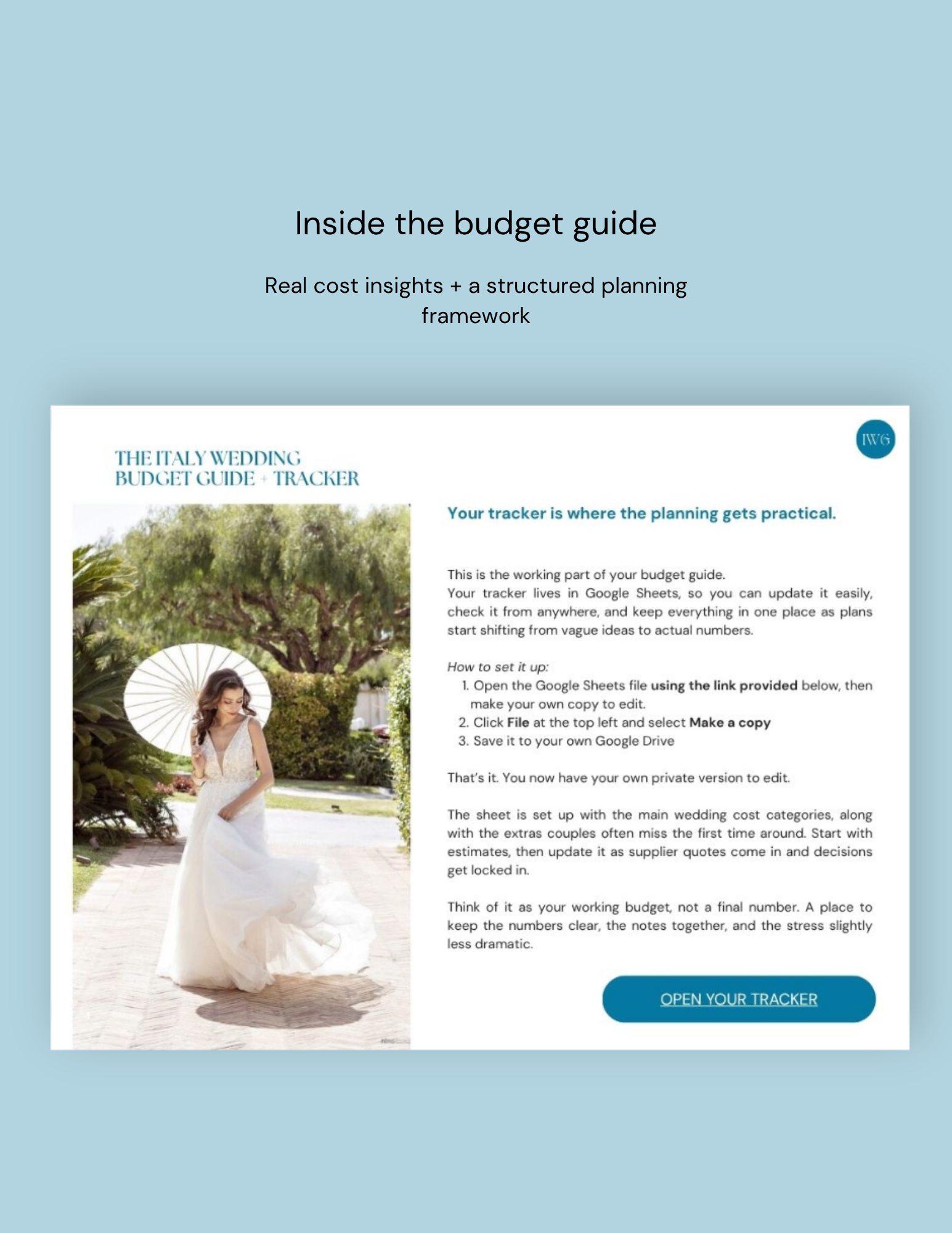
If you want to see how these numbers translate into a real budget structure, the Italy Wedding Budget Guide + Tracker gives you example budgets, hidden cost prompts, and an editable planning sheet to help you map everything out clearly from the start.
Venue Costs for Weddings in Italy
Venue costs in Italy can vary dramatically depending on the type of location you choose and what is included in the package. This is one of the first areas where couples either feel relieved or completely thrown off, because not all venues charge in the same way.
At one end of the spectrum, you have restaurant-style or more inclusive venues where there is no separate hire fee at all. Instead, the space is included when you meet a minimum spend on catering. This can be one of the most effective ways to keep your budget under control without sacrificing atmosphere, especially if food and experience are already high on your priority list.
At the other end, standalone venues such as villas, estates, or historic properties usually charge a hire fee that can range from around €3,000 to €10,000 or more. Premium locations can stretch higher again. Mid-range venue rental often falls somewhere between €4,000 and €7,000, but the real question is never just the hire fee itself. It is what that fee actually includes.
Some venues include staffing, furniture, lighting, or basic coordination, While others provide only the space. This is where budgets begin to shift. A lower rental fee can sometimes lead to much higher overall costs once you start bringing in everything else separately. Understanding what is included before committing to a venue is one of the most important financial decisions you will make.
Catering and Drinks Costs for Weddings in Italy
Catering is usually the largest part of a wedding budget in Italy, and for good reason. Food and drink are not just a practical part of the day here. They are often one of the main highlights of the entire experience.
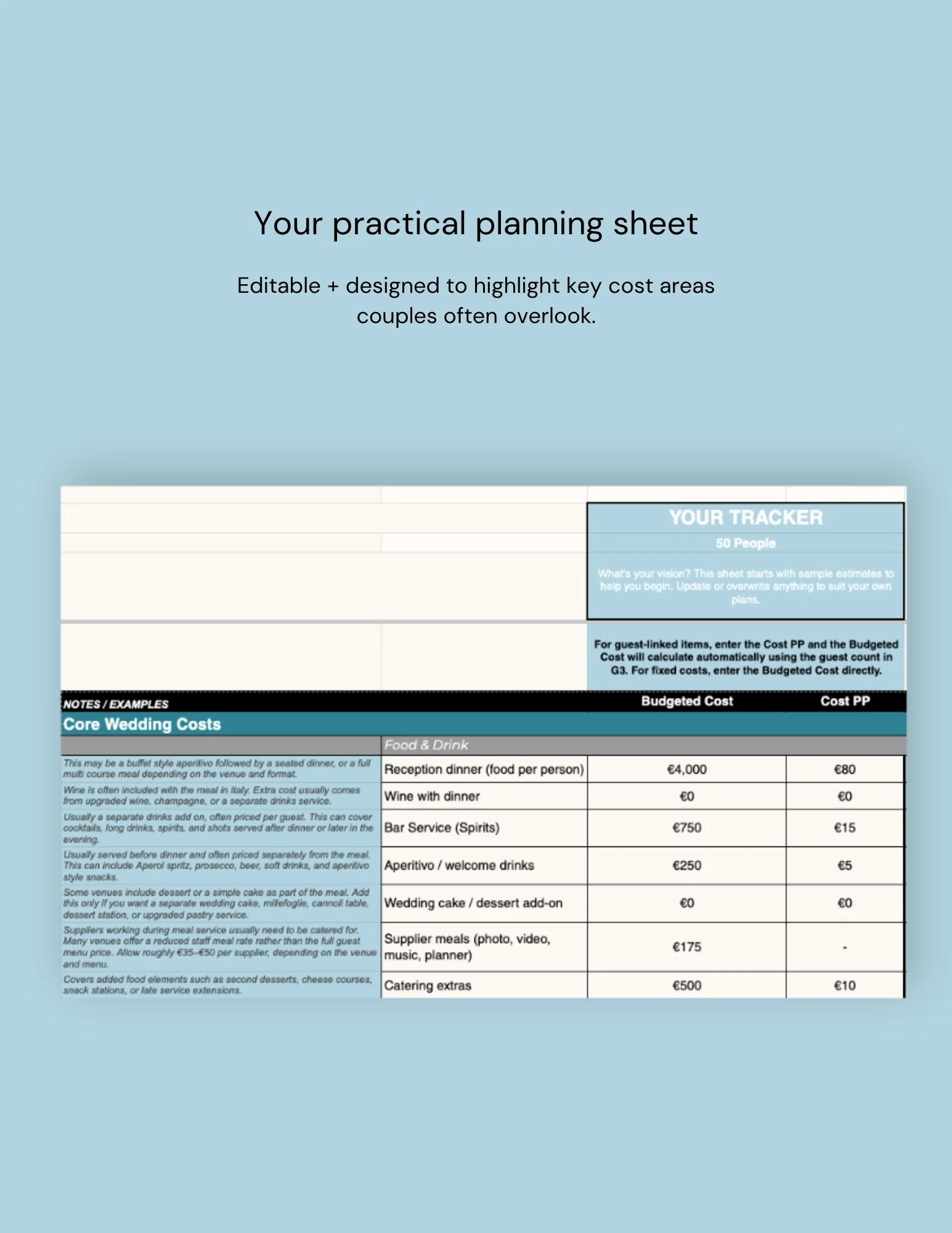
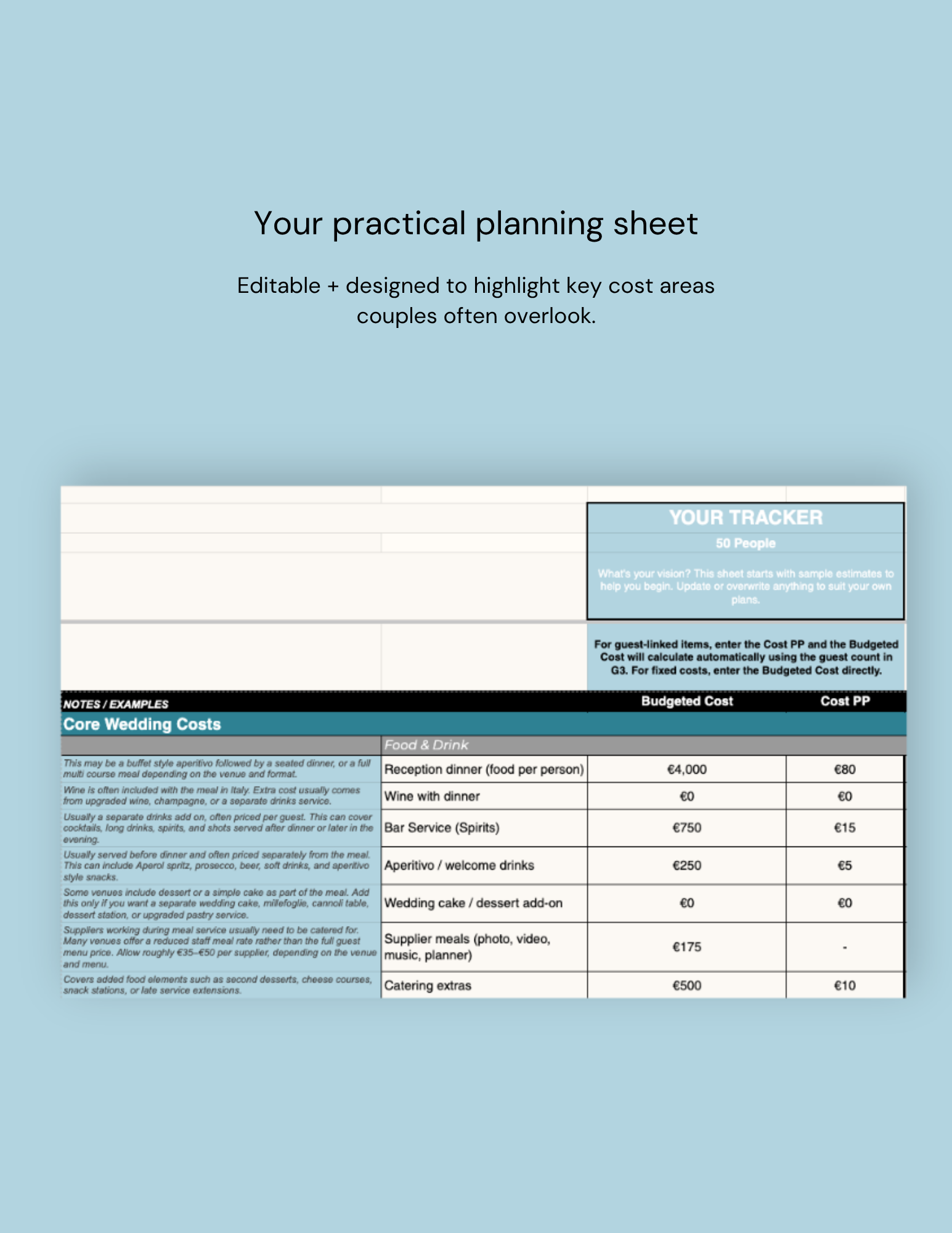
Base meal pricing usually begins around €80 per person and can climb to €180 or more depending on the venue, region, service style, and menu. In reality, most couples do not end up paying just a simple flat rate. Once you factor in aperitivo, wine, service, extra courses, dessert upgrades, and bar packages, the total cost per person rises quickly.
For a wedding of around 50 guests, simpler food and drink setups may land in the lower thousands, While a more polished mid-range experience usually climbs significantly higher. At the upper end, particularly in premium locations or for multi-day celebrations, food and drink can easily become one of the biggest anchors of the budget.
It is also important to separate the different parts of the food experience. Dinner is one line item. Aperitivo and welcome drinks are often separate. Bar service after dinner is usually a separate add-on too. Cake or dessert can be included with the meal at some venues, but at others it becomes another extra cost entirely. This is exactly why two weddings with the same guest count can end up with very different totals.
Another cost that often catches couples off guard is supplier meals. Photographers, videographers, musicians, planners, and other suppliers working through meal service usually need to be catered for. Many venues offer a reduced staff meal rate, but it is still a cost worth planning for early.
Ceremony Costs in Italy
When couples first start budgeting for the ceremony itself, confusion usually comes from not knowing whether they are planning for a symbolic ceremony or a legal ceremony in Italy. In most cases, it is one route or the other, not both, and understanding that distinction makes the numbers much easier to manage.
A symbolic ceremony usually sits somewhere between €500 and €2,000 depending on the celebrant, the format, and how tailored the service is. For many couples, this is the simpler and more flexible choice, especially when the legal paperwork is completed at home and the Italian celebration is focused purely on the experience.
A legal ceremony in Italy can also be quite manageable, but it comes with its own set of administrative costs. These can include documents, translations, interpreter support, stamps, and local bureaucracy. A reasonable budget range is often around €500 to €1,500, depending on the location and setup.
Beyond the ceremony itself, there are often a few smaller technical costs to consider. Outdoor ceremonies or civil ceremonies may require a microphone setup so guests can hear clearly. Music licensing fees may also apply if live or recorded music is being used. These are not usually the most glamorous line items, but they are part of building a realistic budget.
Music and Atmosphere Costs
Music has a huge impact on how a wedding in Italy feels, but costs can vary a lot depending on how much atmosphere you want to create and at which points in the day.
Ceremony musicians might be as simple as a solo guitarist or violinist, or as layered as multiple live sets throughout the event. DJ and sound setup costs usually reflect not just performance, but microphones, speakers, and the technical side of keeping everything running properly. Live bands, if included, can quickly move the budget upward again.
It is also worth remembering that Italy has licensing rules around music, and this is one of those practical details that many couples do not discover until later. Whether it is a ceremony musician, a DJ, or music during dinner and dancing, the associated music tax or permit fees should always be factored in.
Photography, Videography, Flowers, and Styling
This part of the budget tends to scale less with guest count and more with ambition. A wedding with 50 people can still have a substantial styling and capture budget if the visual details are a major priority.
Photography in Italy often starts in the lower thousands and moves upward depending on coverage time, travel, editing style, and the final deliverables included. Videography is optional for some couples, but when it is included, it often covers ceremony audio, speeches, and a fuller record of the day beyond still images.
Flowers, décor, and lighting are one of the most flexible categories in the entire budget. A minimal and elegant floral approach will sit in a very different range from a highly styled dinner setting with overhead installations, candles, layered table details, and lighting design. The same goes for stationery and signage. These details can remain beautifully simple, or they can become a much more developed visual category depending on your priorities.
This is also one of the reasons why comparing weddings purely by guest count does not work. A smaller wedding can still feel expensive if design is one of the main priorities, While a larger guest list can sometimes stay more controlled if the overall styling is kept simple.
Transport, Planning Support, and Logistics
Logistics are one of the most underestimated parts of an Italy wedding budget, especially for couples planning from abroad. These costs often do not feel especially exciting, but they are the ones that make the day actually function smoothly.
Guest transport becomes relevant quickly if your venue is rural, your guests are staying in multiple places, or the wedding takes place across more than one location. A single shared transfer may be quite manageable, but more complex logistics can build quickly depending on timing and distance.
Vendor travel, accommodation, and overtime are also worth considering. Remote venues, late finishes, and multi-day events often increase supplier logistics, and those costs can show up late if they are not discussed clearly from the start.
Planning support is another category that shifts significantly depending on the type of wedding. A simpler celebration may involve no external planning support at all, relying instead on the couple, venue, family, or trusted suppliers. A more flexible mid-range wedding may include partial planning help or on-the-day coordination. A more luxury-led wedding often includes fuller planning and coordination support, which needs its own budget line rather than being treated as an invisible extra.
The Hidden Costs Couples Often Miss
The biggest issue with wedding budgets in Italy is not usually one major dramatic cost. It is the collection of smaller costs that are easy to overlook early on and much harder to absorb later.
These can include supplier meals, planning trips, tastings, wedding insurance, vendor overtime, guest transport extras, thank-you gifts…and so many more! None of these feels especially huge on its own, but together they can shift the overall number far more than couples expect.
This is why so many early budgets feel optimistic. They usually account for the obvious categories first, then the “little extras” slowly appear one by one. The result is not necessarily overspending in a reckless sense. It is more often a lack of structure from the beginning.
That is also the reason the Italy Wedding Budget Guide + Tracker is so useful. It is not just there to total your numbers. It is there to help you see what elements need to be considered row by row, with structure in mind, before the surprises start stacking up.
Get the Budget Guide + Tracker →
So, How Much Should You Budget?
A realistic Italy wedding budget is not about choosing one magic number and hoping it all fits. It is about understanding what kind of wedding you are building and how your priorities shape the overall spend.
A simple wedding can absolutely be beautiful, relaxed, and deeply special without becoming overcomplicated. A more flexible wedding usually allows more styling freedom, a slightly less inclusive venue setup, and more supplier support. A more luxury-led wedding brings a higher level of design, logistics, and guest experience, but it also requires a much stronger financial framework.
The most useful thing you can do at the beginning is stop asking, “What does a wedding in Italy cost?” and start asking, “What kind of Italy wedding are we actually planning?” That question leads to much clearer decisions.
Plan Your Budget with More Clarity
Trying to build your wedding budget from scattered notes, Pinterest screenshots, and half-remembered quotes is exhausting. A clear structure makes everything easier, especially when you are planning from abroad and trying to make decisions confidently.
The Italy Wedding Budget Guide + Tracker includes example budgets, hidden cost prompts, and an editable working sheet so you can organise your own numbers, compare quotes properly, and plan with much more clarity from the start.
Designed for couples planning from abroad, it helps you understand not just what things cost, but what actually needs to be considered.
Start budgeting with clarity →

What Actually Makes an Italy Wedding Budget Feel Manageable
Italy weddings can be simple and soulful, more flexible and design-led, or fully elevated and luxurious. What matters most is not chasing the lowest number or assuming the highest number applies to you. It is understanding the structure behind the celebration you actually want.
Once you know where the money goes, budgeting becomes much less overwhelming. You stop reacting to quotes and start making decisions more confidently. And that is usually the difference between a wedding budget that feels stressful and one that feels surprisingly manageable.
Ready to Budget with More Clarity?
A lot of couples think budget stress starts when the quotes roll in.
Usually, it starts earlier, when you are guessing.
Guessing whether Lake Como is even realistic. Guessing what a good venue should cost. Guessing how much your guest count quietly changes everything.
That is where the spiral begins.
The goal is not to suck the fun out of planning with a giant spreadsheet. It is to understand your numbers early, so you can make smart choices without second guessing every decision.
That is exactly why I created the Budget Guide and Tracker.
It helps you map out your spend, get clearer on your priorities, and understand what is actually realistic for your wedding in Italy, before you waste time on options that were never the right fit.
And yes, it is an instant download, so you can open it straight away and go through it in your own time.
[Explore the Budget Guide and Tracker]
Elisa x
Your Italian Wedding Guide and Planning Bestie
A lot of couples think budget stress starts when the quotes roll in.
Usually, it starts earlier, when you are guessing.
That is exactly why I created the Budget Guide and Tracker. It helps you get clear on what is realistic, organise your spending, and make smarter decisions before the budget starts drifting.